
CONTEXT
Developed as a team project at the Royal College of Art, Feedie explores how working households could access community food support more clearly and with greater dignity. Food insecurity affects 14.1 million people in the UK, and 58% of those facing hunger and hardship live in a working family. Our research focused on households whose income is still not enough to meet their food needs.
Source: The Cost of Hunger and Hardship (2024) - Trussell Trust
14.1 M
individuals facing food insecurity
58%
of people in need are "Working Households"
1 in 6
households were food insecure
Research
Understanding the System
We combined field observation, volunteering, stakeholder interviews and desk research to understand how food support works in practice. This helped us identify recurring challenges for both recipients and volunteers.


Understanding Working Households
Through interviews and field research, we focused on working households struggling to keep up with rising living costs. We created Sam as a composite persona based on the recurring needs and experiences we encountered.

Mapping the Experience
Mapping the journey from seeking support to receiving food revealed challenges for both recipients and volunteers.

Key Insights
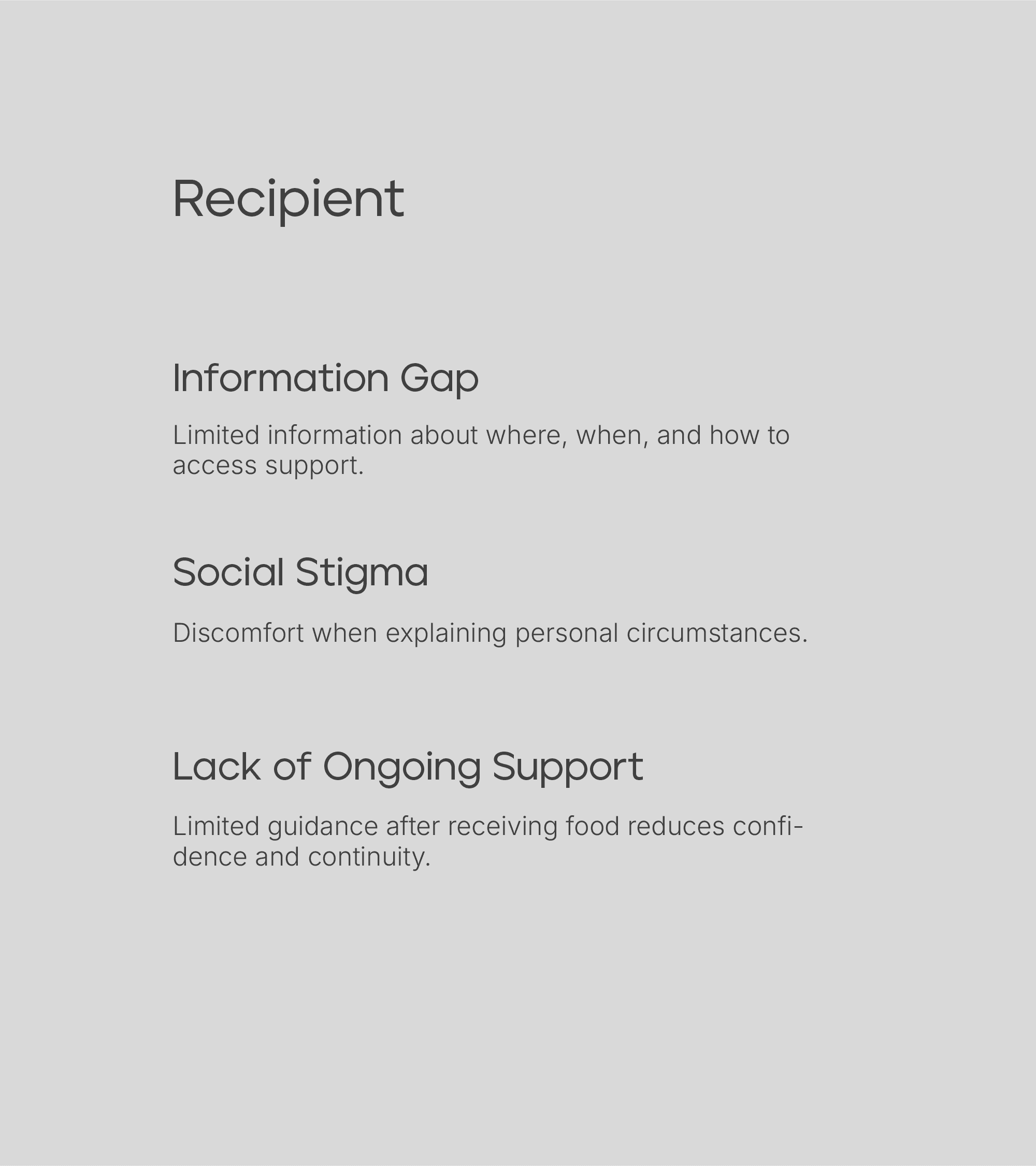


The food support system operates through a narrow and unstable entry structure,
making access unpredictable for working households and operationally fragile for communities.
This led us to ask:
How might we redesign the entry structure of community food support to better accommodate working households while easing operational strain?
Strategy
From Surviving to Thriving
To move beyond emergency food provision, we used the Food Ladders framework, a community development model that sees food support as a progression from meeting immediate needs to building longer-term resilience. We translated this framework into three directions for Feedie: Access, Engage and Grow.
Source: Food Ladders, Blake, 2019.
A clip from our volunteer experience

From Strategy to Experience
A clearer way to connect with food support
We created Feedie, a platform that serves as a portal to bring all the scattered pieces together. It enables people to more easily access food support while helping community food hubs coordinate day-to-day operations more effectively.

01 Access
Search, Find, and Use
Bringing scattered service information and booking into one place, making it easier to search, check, and plan ahead.
Addresses
▪ Fragmented information across food support providers
▪ Unpredictable rules and service hours
▪ Repeated explanations of personal circumstances
Design Interventions
▪ Identity Verification & Registration
▪ Information Portal
▪ Booking System

02 ENGAGE WITH the COMMUNITY
Stay Connected
Making local events more visible and easier to join, allowing people to learn from others, exchange experiences, and build meaningful community connections.
Addresses
▪ Limited visibility of community activities
▪ Social isolation beyond food collection
▪ Lack of peer learning and knowledge sharing
Design Interventions
▪ Access to Community Activities
▪ Peer Knowledge Sharing
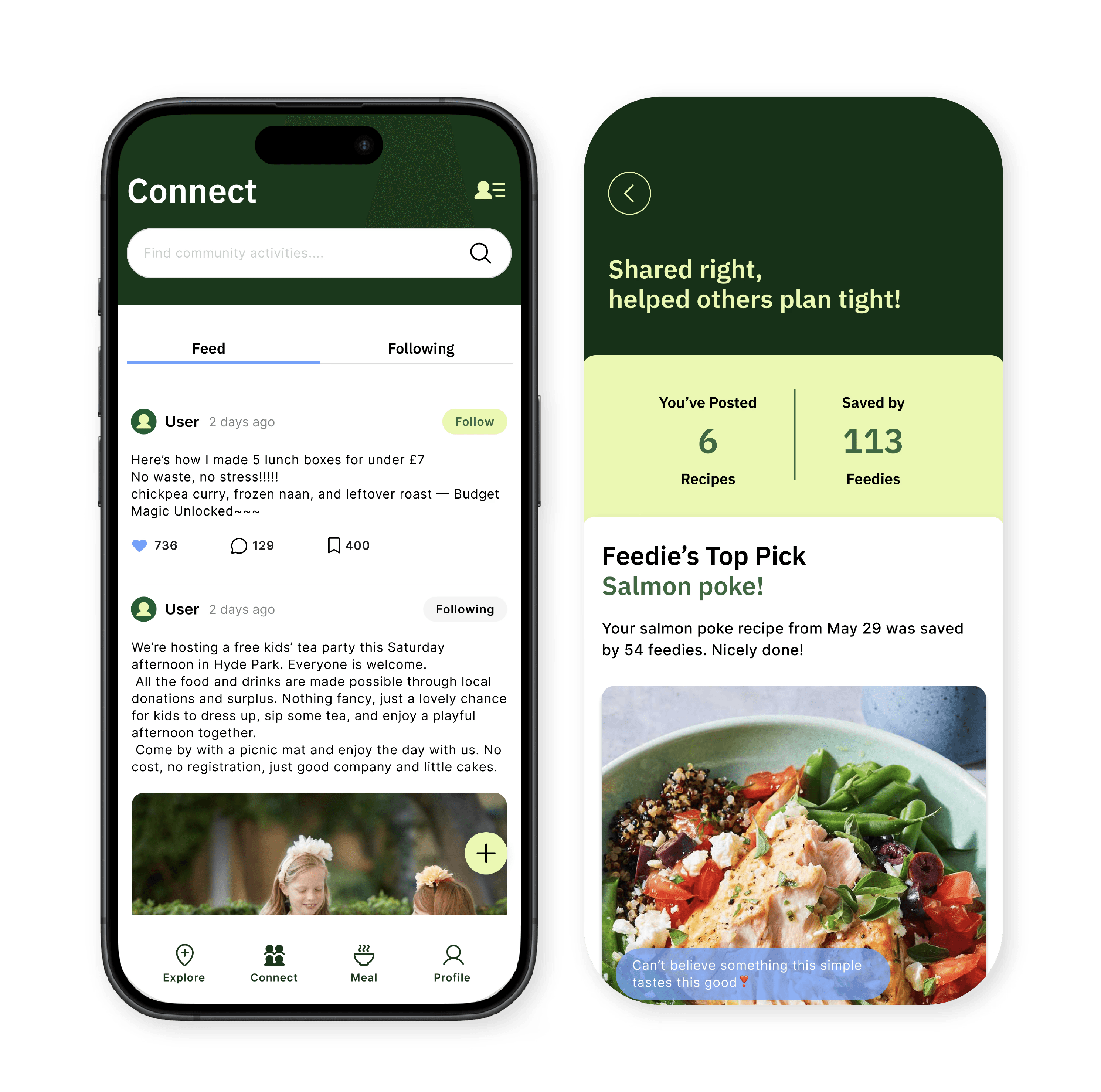


03 GROW WITH CONFIDENCE
Learn, Share, and Grow
Supporting people beyond receiving food by offering recipe ideas, encouraging knowledge sharing, and visualising personal progress to build confidence over time.
Addresses
▪ Difficulty using unfamiliar food ingredients
▪ Limited support after receiving food
▪ Lack of motivation and visible personal progress
Design Interventions
▪ Recipe Discovery
▪ Food Knowledge & Tips
▪ Personal Progress Tracking

For Volunteers
Support with Clarity
Giving volunteers a clearer view of upcoming visits and household needs, reducing repeated explanations and manual coordination so they can focus more on meaningful, person-centred support.
Addresses
▪ Inconsistent systems and workflows
▪ Fragmented household information
▪ Repeated explanations and manual coordination
Design Interventions
▪ Volunteer Dashboard
▪ Household Profile (Family Size, Kitchen Setup, Dietary Needs)


Service Ecosystem
Feedie connects food redistribution organisations, community food support hubs and recipients through local demand feedback and surplus food delivery. By improving visibility across the system, the prototype supports better allocation, stronger support and more dignified access.


Reflection
We tested the concept with food support organisations, who recognised its potential but raised concerns about the resources needed to adopt and maintain a digital platform. As we were unable to test directly with recipients, further validation remains essential. The experience highlighted that sustainable service design depends not only on the solution itself, but also on the partnerships and resources needed to support it.
Acknowledgements
Thanks to Clare Brass, Ruth Brass, Lucinda Croft, Simon Croft, Helen Fielding, and Tommy for their time and insight.